Mama Marie’s pasta sauce

Whether she made it for her famous lasagna, sausage and peppers or stuffed shells, my mother only spared the time and expense of crafting this luscious tomato sauce from scratch when our unwieldy family got together as a group to celebrate something. I have sweet memories of standing on a step stool next to her in the kitchen as she stirred and stirred it in a huge stainless steel pot. She told me stories of doing the same exact thing while her grandmother made this sauce using the recipe she brought with her from Sicily.

Who knows how many generations of Italian cooks made sauce just this way for their families?

2 tbls olive oil

2 cans Hunts tomato sauce

1 small can Contadina tomato past

1 large can crushed tomatoes in puree

My mother told me to be sure each can came from a different company, for a better blend of flavors.

Turn on a very large oval crock pot to ‘high’. Add 1 tbls olive oil to crock and rub, covering  bottom and all sides. When hot, add the tomatoes and stir.  You need to cook the tomatoes before you add water to prevent spattering.

1 whole large brown onion, minced very fine

1 whole head of garlic, peeled

2 stalks of celery, minced very fine

1 carrot, shredded

1 bunch of Italian parsley, chopped fine

3 tbls Italian seasoning or Herbs de Provence

1 tbls  oregano

¼ tsp whole anise seed

¼ cup olive oil.

1 sprig of rosemary

1 small red chili. I’ve used a large dried Poblano pepper, too.

Place a large skillet on med-high and add ¼ cup olive oil. Separate ½ of the garlic cloves and chop fine. Take the chopped garlic, onion, celery, carrot and add to the oil. It should sizzle if the pan is hot enough. Stir to brown. Then crush spices between your hands and add to the onion mixture in the pan and stir. My mother used to say the oil helped bring out the herb flavor to it’s fullest. Continue to sauté until the onion bits are clear and starting to turn brown. Stir the onion mixture into the tomatoes, then return the skillet to the stove.

1 stick of salted creamery butter, cut into cubes (for vegans eliminate this ingredient and add 2 more tbls olive oil.)

2 tbls olive oil

1 cup of good red wine

1 lb medium brown mushrooms, all about the same size, rinsed, patted dry and sliced thickly.

Chop the remaining garlic cloves. Add oil to skillet, then butter. Stir until butter is mostly melted, then add garlic and mushrooms. Stir to coat. Try to keep the mushroom slices flat in the pan and not crowded for better browning. If necessary, brown the mushrooms in batches. When mushrooms are just soft, add wine. Cook for about 10 minutes until mushrooms are browned, then add to the tomatoes.

For vegetarians, eliminate this part:

1 lb extra lean ground chuck

1 lb extra lean ground pork (Italian sausage is the best!)

Brown both meats in the skillet, chopping and mixing them with a wooden spoon. Drain, and add the meat to the tomatoes in the crockpot. Add chopped parsley, chili pepper and stir.

Or, slice the Italian sausages in half, brown, and serve on the side.

Or, make meatballs out of the chuck and sausage and stir into sauce, or serve on the side.

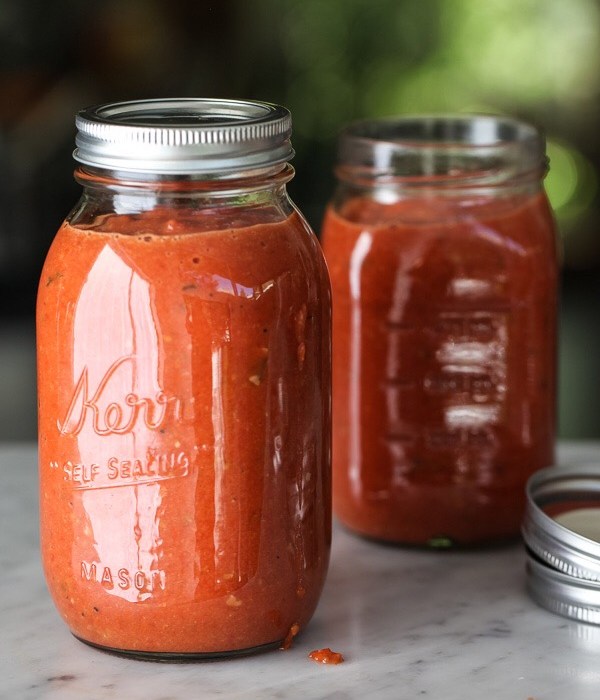
Put lid on crock and cook on high until the sauce bubbles, then add 1 cup of water (or more if it seems too thick), stir in 1 heaping tbls sugar, brown or white, and put the lid on.  Cook for another 3 hours. The idea is to cook the tomato sauce just until it loses it’s bright red color, but before it turns brown. This sauce keeps for a long time in the freezer, but I’ve also canned it for gifts.

Food and Love

My mother was a prim and proper, solidly middle class Italian woman raised by her prim and proper, solidly middle class Italian grandmother. My mother’s own mother wasn’t very maternal nor very interested in domesticity, so my mother spent many hours with her grandmother, cooking. Food was love in her household, because food and Italian grandmothers and love are irrevocably and inescapably stitched together by centuries, no, thousands of years with an invisible thread. Every event, every holiday, every child’s birthday or aged grandparents death was marked by food—copious and ridiculous amounts and abundant varieties of food.

My strongest maternal bonding memories can’t be separated from the food we made and the food we ate and the food we shared with our family. If I conjure the mental image of a huge glass plate bearing glistening peppers in olive oil and garlic, the sprinkling of tiny flakes of char marring the pristine green and red of the peppers, I can resurrect the face of my paternal grandma Yolie. She taught me to make the dish when I was ten, and I smile as I remember standing next to her in front of her white six burner range. Grilled Italian sausage, spicy and sweet, reminds me always of my elderly neighbor, Mrs Taormina, and the lovely welcome-to-the-neighborhood lunch she made for my new husband and I.

Boiled chicken makes me think of my mother stirring a huge pot of it as I bounced into the kitchen after school, a secret weapon in her battle to stay slim. And don’t get me started on lasagna and the three day cooking extravaganza every thanksgiving triggered. That giant pan of lasagna was a much more important and anticipated centerpiece on our long family table than the turkey. Hot and melty on a plate or leftover from the fridge the next day, I’d choose a bowl of my mothers cold lasagna over chocolate ice cream in a heartbeat.

Now that I’m older I try unsuccessfully to separate food from love and emotion. I’m not a dog, I tell myself, I don’t need a treat when I’m good. But now that my mother’s gone, and my grandmother’s gone, and Mrs. Taormina is gone, and my brother and my father are gone, I need food sometimes, to bring them back to me. I’m the older generation now so I wonder, when I’m gone, will my children think of me when they eat lasagna?

Watering Dirt

Once during a family get together a friend and I compared favorite quotes. When it was my turn, I thought for a bit and then answered, “Bloom where you’re planted.” My daughters both said, almost in unison , “No Mom, that’s not what you always say! You say, “Water the dirt—you never know what will pop up.”

I think it’s obvious I’m a big fan of making the best of whatever situation you find yourself in. When my daughters were very small I was a young single mom struggling to create a career that would sustain us, I never had the funds for a highly polished and landscaped living situation. We always had to make due with a fixer-upper rent house, usually un-landscaped. I can smile now, as I remember standing in the dirt at the end of a very long day, a citronella candle burning and a watering hose in my hand. Watering plants can be satisfying and metatative. But by its very nature, watering dirt requires a strong faith in and hope for the future.

As I water, I see sprigs of grass in my mind and before long, I see sprigs of grass sprouting in the once-barren earth. I’d pay special attention to these. Often when I didn’t have time to do the whole yard, I’d just soak those tiny, hopeful sprouts. And they spread. Eventually they would connect with other tiny, hopeful sprouts and we would have a yard of sorts, with holes. Then, i’d hand water the holes. When I bought the property where my salon now lives, we had to remove about five years of oak tree leaves. So, when the leaves were finally gone I started watering the dirt of my new property. In about a year one side of my front yard had grass. As I was watering the dirt in the other side, a client walked by and commented as she saw me water, “What are you doing?” she asked me. “I’m watering my lawn”, I said. “Well, it looks like your watering dirt!” she said. I smiled and said, “Actually, I’m creating an environment which grass will be attracted to and encouraged to thrive.” Sigh. The true secret to life.

Your to-do List

A client shared some humorous anecdotes with me about moving into her new house, and one of them stuck in my mind. “I found an old To-Do list in the back of my junk drawer, and you know what? I’ve accomplished everything on that list, even the projects that seemed out of reach to me at the time I wrote it.” Later that week another client said the same thing about one of her old boyfriends. “He was a French pop star and I was completely enamored of him. I put a date with him at the top of my to do list and kept it there for a year. Believe it or not, at the end of that year I was going out with him on a regular basis.” 
In today’s fast-paced world many of us create daily to-do lists as a matter of course, to try and stay organized and on top of our lives. How many of us look at those lists casually, dismissing them as wishful thinking? Well, don’t. Try to see your to-do list as statements of intent, less a request than an order form. “This is what I will produce today”, or this week, or next month or this year. 

Intention is a powerful tool. Positive, deliberate intent, written down, carried around and re-read frequently possesses the double whammy of intent plus action. You may not see writing something down as action, but it is, and it just may be your first step towards the culmination of a project. 
Dr. Martin Luther King once said in his famous speech, “You don’t have to see the whole staircase to take the first step”. Writing down our intent is the soul equivalent of taking that all-important first step. Maybe you haven’t a clue how to accomplish what you have on your To-Do list. Maybe you have a general outline in your mind but no specifics. Here is where magic comes to play. 
In the book “The Magic Power of Deliberate Intent” by Esther and Jerry Hicks, the action of writing down your intention infuses your intent with power because words have power—ask any child. So be mindful. Word the intent on your list in a positive way. Say “I am” instead of “I want to” or “I’ll try”. As Yoda told young Skywalker, “There is no Try. There is only Do.” 

Kitchen Sinks

My mother used to tell me, “Deborah, always be sure you live in a house with the kitchen sink under a window or you’ll never want to wash your dishes”. I considered those words poignant but old fashioned, an antiquated statement about a woman’s place. In fact, in the 1994 film ‘Muriel’s Wedding’ Muriel’s mother sets fire to a tree outside the window over her kitchen sink. For 20 years she watched that tree get taller and taller while she was stuck in the same place. I understood completely. 

Yet as I got older and was faced with a life of renting houses, I found myself discarding choices where the kitchen sink faced a wall in favor of a window of any size over the sink. In this modern age of automatic dishwashers, we don’t spend much time contemplating life from the kitchen sink, or any other place, but we never get away from mundane chores. Mundane chores are a constant in our lives, no matter who we are.

I’ve found I like to use this ‘window-over-the-sink’ trick myself now, or something like it, to make hand-washing my dishes, or peeling shrimp, or loading the dishwasher an enjoyable experience. Now that I’m sort of a grown up and a homeowner, I can bust out any claustrophobic wall or too-small window with confidence. I recently knocked out my ordinary kitchen window and replaced it with a custom ten-foot monster, and I’m here to tell you, it changed my life. Now I get to look out over the Hill Country, let my mind wander and almost like magic, my dishes are done and all’s right in my world. 

 Now that I’m sort of a grown-up, I see my mother’s kitchen sink advice as an ‘always-take-the long-way-home-style metaphor. I like to find the best view of nature wherever I am because looking at beautiful things makes all mundane chores easier, don’t you think?

When we consider what this life demands of us choosing the prettier commute, or a nicer way to say something,  or a window over our sink, can be imperative for our own inner peace. Now that I’m sort of a grown-up, I always try to find the best way to maintain my inner peace, and I’ve found it’s a little easier to do with a view of nature wherever I am. Try it—it works.

I believe in placebos

I once spent a drizzly Sunday afternoon playing Scrabble with my mother-in-law. She was having a hard time recovering from her stroke and Scrabble was her favorite game. Before the stroke no one could beat her. I made a double batch of cookies and stuffed them full of oatmeal, chocolate chips, sun dried cherries and coconut. As she struggled over and over to spell words she once found effortless, we managed to eat the entire batch of cookies, just the two of us.

Did the cookies help cure my mother in-law’s stroke? I believe, for that one day, they did. She definitely played Scrabble better than she would have without them. Her recovery was a long and painful process and those cookies eased the pain a bit that afternoon.

The word ‘placebo’ is defined as “a harmless pill, medicine, or procedure prescribed more for the psychological benefit to the patient than for any physiological effect.” This could take many forms. Vitamins. Crystals and stones, home alarm systems—these all are alternately proven and disproven to be healthful and real. But as we take our vitamins every morning, don’t we recite (at least in our minds)  “ . . . glucosamine for joint health, co-q-10 for mental clarity and improved heart health . . . “? Yes we now have scientific proof of the benefits of vitamins, but the most important benefit may be that we believe in them and the litany we recite to ourselves as we swallow them. How many of us collect stones and crystals, thinking “ . . . citrine brings wealth, black tourmaline protects from negative energies . . .” . And, how many sports figures are superstitious about the socks they wear during a winning streak, or a lucky glove?

When my son was very young I placed a kiss on the back of his hand after I put on my lipstick. Looking at it seemed to help calm him if his school day got difficult. And how many times have we made our children’s ‘ouchies’ feel better just by kissing them?

Studies show those of us who get a kiss in the morning go off to have a better day at work than those who don’t. Children almost always cling to a blanket or stuffed animal for comfort. And it works—ask any parent. I don’t know about you but I’d rather believe something I’m doing is making me well. It feels good to believe we’re getting better, and feeling good helps us get better.

On the subject of placebos, the website ‘I f**king love science’ wrote “If you’re not completely blown away by the power of placebo, then you don’t know enough about it. It’s the closest I’ve ever seen to actual magic.” Placebos work even if the person taking them knows they’re placebos, found one Harvard study. It’s a physics principle—the observer affects the experiment.

We use placebos all the time in our lives. Mostly we are unconscious about it. But . . . what if we began doing it consciously, surrounding our environment with items we know make us feel healthier, more productive, calmer? It may feel silly at first but no one is looking, so why not? What if it works?

How to be Happy (or happily married)

Once I had a doctors appointment, and while I was waiting in the office I went into the kitchen to get a cup of coffee. On the wall was a poster titled “How to be happy”. The only one from the twenty-odd bullet points I remember is this: Marry the right person. For some reason that one seared itself into my brain. At the time, I wasn’t married at all, but I’d been married to the wrong person before, so the advice really struck a chord in me.

 And last June Time magazine came out with an issue and on the cover, in huge lettering, were the words “How to Stay Married (and why)”. It became one of the magazines best selling issues that year. Time had all sorts of dramatic covers, yet that one struck a chord in the hearts and minds of America as well. 

So when I recently ran across an article about a 75-year study on relationships, it got me remembering. The article found good relationships keep us happier and healthier. Period. And, as anyone who ever suffered through a divorce can attest, marrying the wrong person can suck the happiness right out of you. 

I carried a book in my salon called “Advice to a Young Wife from an Old Mistress” by Michael Drury. Drury recounts a weepy conversation she had with her father one rainy night about her husband and their impending divorce. “But, I was such a good wife to him!” She wailed, feeling wronged and expecting sympathy. “There’s no such thing as a ‘good’ wife,’ he told her. ‘Only the right wife for each person’. Or husband, or significant other, or partner. Or best friend. 

So just how does one discover that right person? The important answer is also the most elusive—Be one hundred percent authentically who we truly are, and maintain a high level of happiness in our own authenticity. My mom used to say, ‘There’s someone for everyone in this world’, and it’s true—I’ve seen it. 

Like attracts like—It’s a physics principle. We need someone to love us for who we really are, so we need to be that person whole heartedly. And we also need to let them be them, wholeheartedly.  Then, choose well.

Danger = Crises + Opportunity 

As more and more federal agencies close and hiring freezes pop up everywhere, many of us find ourselves unceremoniously dumped back into the scrambling work force. We could be forgiven for believing this a terrible thing and it probably is for many. But not for most, believe it or not. 

 My work is people-intensive and people talk to their hairdresser. Or, they should. We know a lot of stuff, because we love to listen. We can be a kind of a touchy-feely Cone of Silence. All day, every day we listen to all sorts of people in all sorts of professions who do all sorts of things. We talk about hearts desires and we talk about business. A lot. 

So when I start hearing the same thing over and over again from these people, who come from completely different backgrounds, I know I’m on to something. Are these people updating their resumes, setting up interviews, networking their Facebook page? Nope. What I’m hearing people say over and over is, “”I think I’m going to go do something different.” 

So many of us hang on to mediocre paychecks and unpleasant bosses and ridiculous commutes because we feel stuck. Then boom—everything blows up. At first we feel like we’re in danger and the normal, human response to danger is fight or flight. We fight to hang on to what we had because it’s what we know. We’re in a habit of a life and habits are hard to break. Or we want to run fast and far away and sometimes that’s just not possible. After those first impulses, though, maybe we begin to feel a secret exhilaration, as if a difficult decision has been made for us and we’re free.

In the Chinese written language the character used for danger is actually made from two characters, ‘crises’ and ‘’opportunity’ . They believed every crises contains in it the seed for a new opportunity, and it’s true. It does. We just have to open our perception enough to see the opportunity, especially if is an opportunity so small we could miss it, overlook it, discard it like we would a seed. Instead, let’s plant the seed and go do something different.